I sometimes wonder if people realize there are still “Mom and Pop” farms scattered across the countryside.
Not every farmer is planting ten thousand acres with satellite-guided equipment and tractors that cost more than houses. Some of us are still farming a few hundred acres or less, using older equipment and doing things much the way our parents and grandparents did. It is physically demanding.
We are the small potatoes of agriculture. Not the big baking potatoes, either—I’m talking about the little ones you toss into soups and stews. Pardon the potato reference; that’s my farming life and kitchen life colliding.
Modern agriculture is impressive. Large operations have become businesses that require considerable management, planning, and investment. Their challenges are different from ours. But those of us running smaller farms, like my dad, who still farms at the age of 88.5 years young, we face our own set of struggles.
This spring has been especially demanding.
I consider myself a vintage FarmHER. While my brothers and I were raised on John Deere tractors and Ford pickup trucks, somewhere along the way I fell in love with Oliver tractors and Dodge trucks. I’m sure that is a direct influence that my beloved Burton had on my life, from whom I bought this farm. His parents bought this farm in 1936, Burt inherited it in 1944, and we bought it in 1994. (Only three owners in 90 years).
My tractors are old, but I love them. If it were possible to hug a piece of farm equipment, I probably would. Then again, I’m also the kind of person who hugs trees.
(Don’t laugh until you’ve tried it. Walk outside, wrap your arms around a tree, lean your cheek against the bark, and take a deep breath. You’ll feel it clear down to your toes.)
This spring, my Oliver 1855 developed a fuel tank leak. Concerned about the steel’s age and condition, we removed the tank and sent it to a local welding shop to have a new one fabricated exactly like it. That left my Oliver sitting in the barn with its innards spread across the floor while I relied on my backup Cab tractor, a White 2-105 Field Boss.
She’s a beautiful machine, complete with an old 8-track player. Remember those? Four channels and only a handful of songs on each one. That tractor is a rolling time capsule.
The problem is, she rides rough.
Without dual wheels mounted, every bump in the field seemed to travel straight up my spine. By the time I finished plowing and disking, I felt like I’d been bounced apart and put back together INCORRECTLY.
Still, the work had to get done.
Last Saturday, one of my seven Granddaughters, Alaina (& we have five grandsons), wanted to help me tackle corn planting.
For those unfamiliar with planters, they use long marker arms that leave a guide line for the next pass across the field. One marker on my John Deere 7000 worked perfectly. The other refused to cooperate.
That meant I had a marker going east but not coming back west.
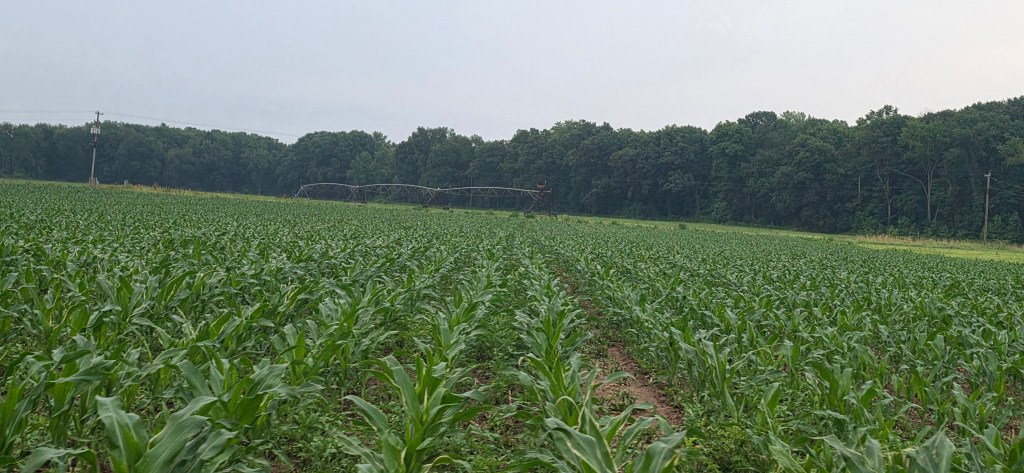
As a result, my cornfield may look as though it was planted by someone who had one too many cups of coffee—or perhaps something a bit stronger. I like doing things well, and crooked rows bother me. But with hay already down and needing to be baled, time slipping away, I had no choice but to plant anyway.
The truth is that many modern farmers simply engage the GPS, and the satellite steers the tractor with remarkable precision. Those beautiful ruler-straight rows you see from the road are often guided by technology.
My rows, on the other hand, were guided by one working marker and a prayer.
An old retired farmer once told me, “Don’t worry about those crooked rows, Sherry. There’s more corn in a crooked row than in a straight one.”
I’ve never forgotten that, and his words never rang truer than they do this year.
What matters is that the corn got planted. As soon as we finished, we unhooked the planter, hooked onto the baler, and put up three fields of hay.
Then came the best surprise of all.
Our only son, Thom, drove up from Indiana. After looking over the old Oliver, he scratched his head and said, “Mom, why did you have a new fuel tank built? I probably could have patched this one for you.”
Within two hours, he had cut out the damaged section, welded in new steel, reinstalled the tank, and put everything back together.
Just like that, my Oliver 1855 was alive again.
I won’t deny it—I nearly cried.
Farming isn’t always about machinery, crops, or cattle. Sometimes it’s about the people who show up when you need them. Sometimes it’s about a granddaughter helping plant corn, a wise old farmer offering perspective, or a son who can fix in two hours what you’ve been worrying and struggling with for weeks.
And sometimes it’s about an old Oliver tractor returning to the field where she belongs.
The rows may be crooked this year, but MY HEART IS PRETTY STRAIGHT on one thing:
I am grateful, from sunrise to Suppertime…..where even crooked rows can grow good corn!

